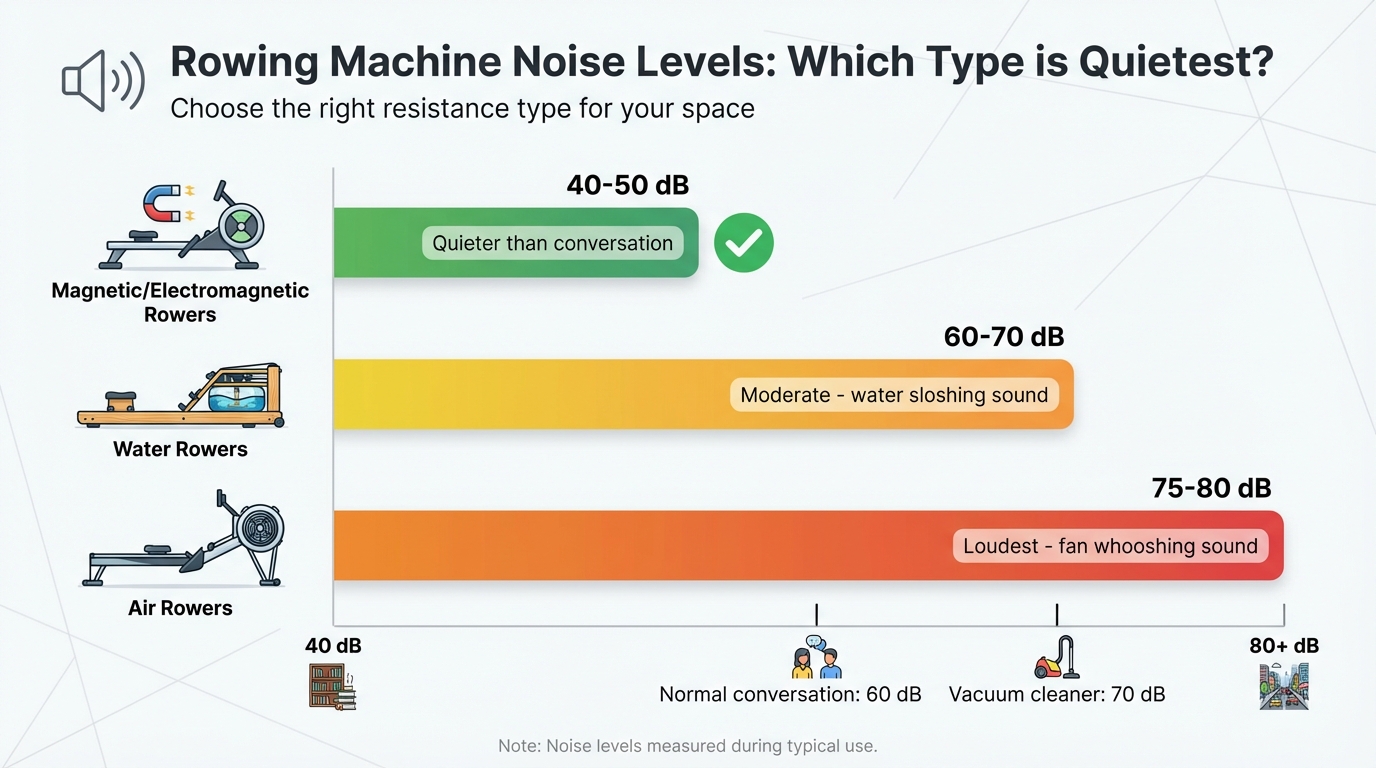
Rowing Machine Noise Levels by Type: Decibel Comparison Chart
Rowing machines can be noisy, but with the right setup and maintenance, you can significantly reduce the sound. Noise mainly comes from the resistance mechanism (air, water, magnetic, or hydraulic) and mechanical parts like chains or seat rollers. Vibrations on hard floors and echoes in empty rooms amplify the problem. Here’s how to tackle it:
For quieter workouts, focus on smooth strokes, proper maintenance, and adding sound-absorbing elements to your space. Investing in a quieter rowing machine or accessories like nylon belts can also help.
Rowing Machine Noise Levels by Type: Decibel Comparison Chart
When setting up your rower, aim for spaces like basements or rooms that naturally provide insulation from sound. Hard floors, like tile or wood, can amplify vibrations, while carpeted surfaces help absorb noise. To keep workouts quieter, avoid placing your rower near bedrooms or shared walls. For extra vibration control, consider adding equipment mats.
A high-density rubber or foam mat is a simple yet effective way to reduce noise and vibrations. Look for mats that are at least 5/16 inch (8 mm) thick. If you’re using your rower on hardwood floors, a thicker mat – around 1/2 to 1 inch – can provide even better noise dampening.
To keep the sound contained, close doors and windows during your workout and seal any gaps with weather stripping. If possible, position the loudest part of your rower away from thin walls. These small adjustments, combined with regular maintenance and smart equipment choices, can go a long way toward creating a quieter exercise space.
Fine-tuning your rowing machine setup can make a big difference in reducing noise, especially when dealing with different types of rowers.
Air rowers are known for their distinct "whooshing" sound, which comes from the fan mechanism. Models like the Concept2 Model D typically produce 75–80 dB during use. The flywheel is the main source of this noise, and keeping it clean can help prevent dust buildup that might make it louder.
The chain mechanism is another potential noise source. A dry or unlubricated chain can rattle, so it’s a good idea to lubricate it regularly to keep things running smoothly. To further reduce noise, place your air rower on 1.0-inch thick interlocking foam mats, especially if you have hardwood floors, as this can help dampen sound.
At lower intensity levels (slower than 2:30/500m), air rowers are relatively quiet and unlikely to disturb others. However, when rowing at higher intensity (around a 1:45/500m pace), the noise level increases. For intense workouts, try scheduling them during active hours and save quieter, steady-state sessions for early mornings or late evenings.
Water rowers operate at a lower noise level, typically around 60–70 dB, with the sound coming from the paddles moving through water in the tank. To keep the noise consistent, maintain the recommended water level and avoid irregular splashing by ensuring proper resistance settings.
For the best results, use municipal tap water in the tank. The chlorine in tap water helps prevent algae growth and keeps the water clear. If the water becomes cloudy, it’s better to completely drain and refill the tank using a siphon rather than relying on additional chemicals. Adding purification tablets with about 167 mg of troclosene sodium every six months also helps protect the seals and maintain water quality.
Occasionally, loose bolts in the tank or frame can cause the paddles to grind against the tank walls, creating unwanted noise. Tighten these bolts monthly using a 5mm Allen key to avoid such issues. This is especially important for wooden frames, which can shift due to changes in humidity or temperature. Placing the rower on a non-slip equipment mat can also absorb vibrations and prevent sound from echoing through the floor.
Magnetic and electromagnetic rowers are the quietest of the bunch, operating at around 40–50 dB – quieter than a casual conversation. As Edwin Murray, the Founder of Rowing Machine King, explains:
"Magnetic and hydraulic-piston rowers make almost no sound, while air and water rowing machines produce a bit more noise".
While the resistance mechanism is nearly silent, noise can still come from the seat sliding along the rails or the pull-cord mechanism. Regularly oiling the seat rails and rollers can prevent squeaks and ensure a smooth glide. Opting for models with nylon belts instead of metal chains can also help minimize noise.
Inspect the magnetic system housing occasionally for loose or bent parts that could rub or catch during use. Finally, focus on smooth, controlled strokes to avoid mechanical banging – jerking the handle or slamming the seat into the frame at the end of a stroke can create unnecessary noise.
Keeping your rowing machine in top shape not only ensures a quieter workout but also extends its life. In fact, about 90% of rowing machine issues can be resolved with basic tools in under 30 minutes. By following a consistent maintenance routine, you can build on the initial setup and keep your rower running smoothly and quietly.
The chain is one of the main culprits when it comes to noise. Without proper lubrication, it can produce a sharp, grating sound. To keep it running smoothly, apply one teaspoon of purified mineral oil, 3‑IN‑ONE oil, or 20W motor oil to a paper towel. Run the towel along the entire chain length every 50 hours of use. Afterward, take 10–20 strong strokes to distribute the lubricant to the internal components.
Avoid using WD‑40 – it’s not suitable for this purpose. Instead, opt for Teflon-based oil. For seat rollers and rails, silicone spray is ideal since it doesn’t attract debris like heavier oils.
The monorail also needs daily care. After every workout, wipe it down using a non-abrasive cloth with soapy water or glass cleaner. This prevents the buildup of black residue, which can cause friction and grinding noises over time. If you notice any stiff chain links that don’t flex properly after lubrication, replace them to protect the sprockets.
Once you’ve lubricated the moving parts, make sure everything is securely fastened. Loose hardware can create rattling noises, so tighten all bolts every 250 hours of use. Concept2 emphasizes the importance of this step, stating: "Use of this machine with a worn or weakened part, such as the chain, sprockets, swivel connector or shock cord, may result in injury to the user."
Footplate screws deserve extra attention, as they contribute to 40% of seat misalignment issues. Use a torque wrench to tighten M6 bolts to 10–12 N·m and M8 bolts to 25–30 N·m, preventing unnecessary clatter. For new machines, especially wooden ones like the WaterRower, gently tighten components within the first two weeks as the frame adjusts to the room’s temperature and humidity. Monthly inspections of the chain-handle junction, shock cords, and monitor joints are also necessary – clunks often point to loose bolts.
If your rower still makes noise, you’ll need to track down the source. Start by rolling the seat along the rails without pulling the handle. Run your thumb along the rail to feel for grit or black residue, which could be causing the noise.
Lift the seat and manually rotate each roller. Grinding sounds or wobbling indicate a bearing issue, and rollers should be replaced if their diameter is less than 1.25 inches. Slowly row while watching the chain pass over the sprocket – stiff links that don’t flex smoothly can cause clicking or skipping noises.
Finally, inspect the flywheel using a flashlight. Look for dust buildup, which can muffle noise and create a gritty resistance feel. Use a vacuum or compressed air to clean the damper blades, directing the air perpendicular to avoid damage.
| Maintenance Task | Frequency | Product |
|---|---|---|
| Wipe Monorail | Daily (After use) | Microfiber cloth, soap & water |
| Lubricate Chain | Every 50 Hours | Mineral oil, 3‑IN‑ONE, or 20W motor oil |
| Tighten Assembly Bolts | Every 250 Hours | Hex key set or torque wrench |
| Inspect Chain/Handle | Every 250 Hours | Visual inspection for stiff links |
| Clean Flywheel | Annually / Every 250 Hours | Vacuum or compressed air |
The way your workout room is set up can significantly affect how noisy your rowing machine feels. Empty spaces tend to amplify sound because hard surfaces reflect noise, creating echoes. As Edwin Murray, Founder of Rowing Machine King, points out:
"An empty room will cause the sound to echo and become louder. Try rowing in a room with furniture or adding items to your workout room to absorb the sound."
To tackle this, focus on adding materials that absorb sound instead of reflecting it.
For example, hang thick curtains, lay down carpets, or even attach blankets to the walls. If you’re looking for a more polished approach, you can create acoustic panels with canvas and stuffing. Bookcases packed with books are another effective way to break up sound waves and cut down on echoes. Got high ceilings? You might want to hang rubber flooring strips or acoustic baffles to catch noise traveling upward.
If you need a quick fix, portable barriers like garment racks draped with heavy blankets can work wonders, especially for shielding shared walls during workouts. Another clever trick involves creating a "sound maze" in air vents. Place four small pieces of rigid foam board in a zig-zag pattern to let air through while blocking noise from traveling to other rooms. Don’t overlook the gaps under doors – installing a heavy rubber door sweep can help keep sound contained.
While improving room acoustics is crucial, the timing of your workouts also plays a big role in managing noise.
When you work out matters, especially if you share your living space. High-intensity rowing sessions generate more noise because the fan operates at a faster speed. Interestingly, rowing at a slower pace – like under 2:30 per 500 meters on a Concept2 – can be virtually silent outside the workout room.
To minimize disruptions, plan your high-intensity sessions for times when they’re less likely to bother others. On the flip side, quieter workouts can be scheduled during times when ambient noise naturally masks the sound of your machine. Using smooth, controlled strokes can also reduce banging noises and wear on your equipment.
If you live in an apartment, it’s a good idea to coordinate with your neighbors. Find out when they’re usually out or active, and avoid rowing during their sleep or quiet hours. Small adjustments like these can go a long way in keeping the peace while you stay fit.

If you’re aiming to create a peaceful workout environment, choosing quieter rowing machines and accessories is key. The noise level of a rowing machine largely depends on its resistance type – this accounts for about 90% of the sound it produces. Machines with belt or strap drives are much quieter compared to chain drives, which can create rattling noises. Also, consider machines with wooden frames, like ash or oak, as they naturally absorb more sound than metal frames. These factors make it easier to narrow down your options when using RowingList.com.
RowingList.com simplifies the search for quiet equipment by letting you filter machines based on resistance type and noise level. For instance, you can directly compare quieter magnetic models with air-based ones, which tend to be louder. The platform also features a variety of accessories, such as high-density foam mats that help reduce vibrations. Whether you’re looking for budget-friendly options like Sunny Health & Fitness models or high-end machines like the Echelon Row-s, which costs around $1,299.99, you’ll find a range of choices.
To make an informed decision, you can use the platform’s side-by-side decibel comparisons to identify the quietest options. Additionally, RowingList.com offers maintenance products like lubricants and cleaning supplies for monorail systems, which are crucial for minimizing mechanical noise over time. By combining the right equipment, proper maintenance, and thoughtful room acoustics, you can create an ideal workout space with minimal noise distractions.
Reducing noise from your rowing machine doesn’t require anything overly complex – just a few straightforward adjustments. Start with the basics: place your machine on a thick mat, at least an inch thick, to help absorb vibrations, especially if you’re rowing on hardwood floors. This simple step lays the groundwork for quieter workouts.
Your rowing technique also plays a major role. Smooth, controlled strokes not only improve your form but also cut down on impact noise. If you’re using an air rower, consider setting the damper between levels 1 and 3 instead of cranking it up to 10. This small tweak can noticeably lower the fan noise.
The acoustics of your space matter too. Adding furniture or sound-absorbing panels can help reduce noise, and scheduling high-intensity sessions during daytime hours can minimize disruptions.
Lastly, the type of rower you use has a big impact on noise levels. Magnetic rowers, for instance, run much quieter at around 40–50 dB, compared to the louder 75–80 dB of air rowers. Whether you’re optimizing your current setup or investing in quieter equipment, combining smart placement, regular maintenance, and thoughtful scheduling can create a more peaceful rowing experience for you and everyone around you.
Rowing machines can get pretty noisy, and in a small apartment, that sound can quickly bounce around and become a problem. But don’t worry – there are a few simple tricks to keep things quieter.
Start by placing a rubber or foam mat under your rower. This helps absorb vibrations and keeps the noise down. Also, make it a habit to check and tighten any loose bolts, as rattling parts can get surprisingly loud. For extra soundproofing, you can add felt strips or isolation pads to reduce friction between moving parts.
Positioning your rowing machine matters too. Placing it near a wall or in a corner can help block some of the noise. You might even hang a heavy curtain or set up a folding screen nearby to cut down on sound reflections. If the seat rail is making noise, a quick fix is to cushion it with something soft, like a towel or a small pillow.
Finally, timing is everything. Plan your workouts during hours when it’s less likely to bother your neighbors. With these steps, you can enjoy a quieter, more neighbor-friendly rowing session.
If keeping things quiet is a top priority, magnetic-resistance rowing machines are a great choice. These machines use magnets to create resistance, which allows them to operate smoothly and with minimal noise – unlike air or water rowers, which tend to be louder during use.
This makes magnetic rowers perfect for home gyms, apartments, or any space where controlling noise levels matters. On top of that, they typically need less upkeep, making them even more convenient.
To keep your rowing machine in top shape and operating quietly, make it a habit to wipe it down after every workout. This simple step helps remove sweat and dust that can build up over time. Once a month, go a bit further with maintenance – clean the machine thoroughly, lubricate any moving parts, and tighten loose bolts. If you’re using the machine heavily or it’s shared in a gym setting, you might want to perform these checks more frequently to ensure it stays in peak condition and runs smoothly.
